
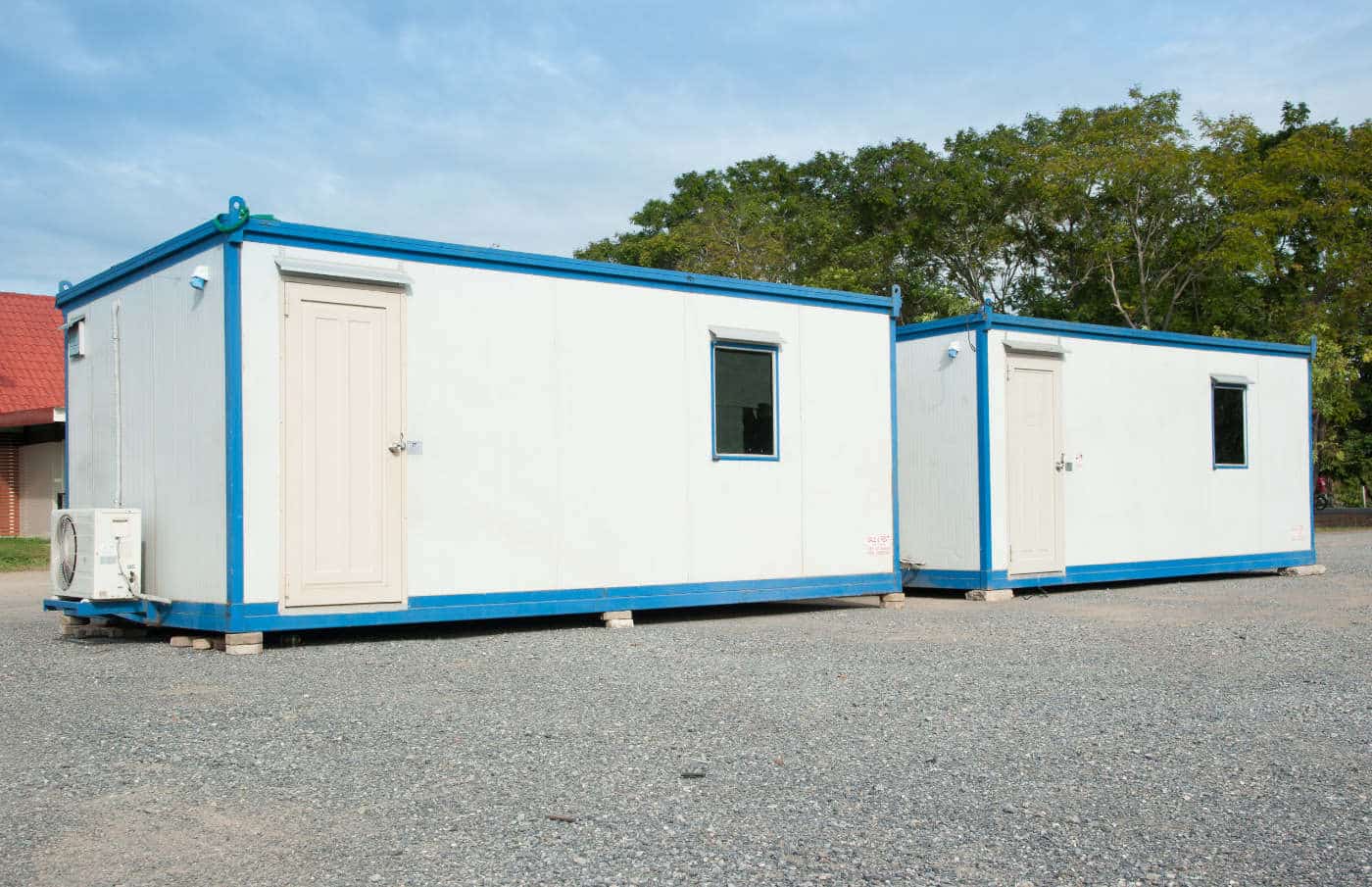
Office Trailer Rental In Texas
Texas runs more mobile office trailers than any state in the country, and it is the one place where the demand splits cleanly in two — general construction in the metros, and oilfield operations in the Permian Basin. What you pay, how fast you get one and what permits you need are different in each.
Rentals run $200 to $900 per month depending on size, with double wides from $700. Below: what to expect by metro, the Texas permit rules that catch people out, and when a trailer falls under state approval rather than a local permit.
Office Trailer Rental Rates In Texas
| Size | Square Feet | Occupancy | Monthly Rental |
|---|---|---|---|
| 8×20 / 8×24 | 160 | 1 – 3 | $200 – $425 |
| 8×36 | 256 | 2 – 4 | $275 – $475 |
| 10×40 | 360 | 3 – 4 | $300 – $500 |
| 12×60 | 672 | 4 – 6 | $500 – $900 |
| 24×60 double wide | 1,344 | 7 – 10 | $700 – $1,800 |
These are national budgeting ranges rather than Texas rate cards — no lessor publishes rates in any state. Two things push Texas quotes around within them:
- Yard density. Houston, Dallas–Fort Worth and San Antonio all have multiple national lessor yards, so transport is short and competition on price is real. The Permian Basin and West Texas are a different story, covered below.
- Oilfield cycles. When Permian activity is up, fleet availability across the whole state tightens and rates follow. A quote taken during a drilling upswing and one taken during a slowdown are not the same quote.
Our office trailer rental guide covers how lease term changes the rate, and what is excluded from every monthly figure.
What An Office Trailer Costs In Texas
Texas prices below the national average on the trailer itself and above it on the round trip, because the distances are longer than almost anywhere else in the country.
The monthly rate is set by the same things it is everywhere — size, term, and how many yards serve your market. What is distinctly Texan is the second half of the bill:
- Delivery distance. A Houston or DFW site is usually within an hour of several yards. A site between Midland and Del Rio may be three hours from the nearest one, and the haul is charged both ways.
- Permit cost on anything over 8’6″ wide. A 10-ft or 12-ft trailer needs a TxDMV oversize permit for the move, which is a real line item and applies to delivery and return separately.
- Escort cost above 14 ft. Only the halves of a 28×74 hit this, but when they do it is the largest single charge on the move.
- Anchoring on the Gulf Coast. Wind requirements south and east of Houston mean more tie-downs than an inland site, and some jurisdictions want an engineer’s letter.
Ask for the delivered total to your actual site address, not to the metro. Texas is wide enough that two sites in the same county can carry materially different delivery charges, and “Houston area” covers a hundred miles of difference. The rate table above is the trailer; the address decides the rest.
For the national picture on what is and is not included in a monthly rate, see the office trailer rental guide. The rates and inclusions there apply in Texas; what changes is the distance and the permit.
Texas Oversize Permit Rules — The Part Most People Get Wrong
A 12-foot-wide office trailer needs an oversize permit in Texas. It does not need an escort vehicle. That surprises people, and it is worth knowing before you accept a delivery quote that prices one in.
TxDMV escort requirements start above 14 feet:
| Load Width | Escort Required | What It Means For Office Trailers |
|---|---|---|
| Up to 8 ft 6 in | None — legal width | 8×20 and 8×36 move as standard loads |
| 8 ft 6 in to 14 ft | None | 10-ft and 12-ft-wide units: permit only, no escort |
| Exceeding 14 ft to 16 ft | 1 front on two-lane, 1 rear on multi-lane | 14-ft sections of a 28×74 double wide |
| Exceeding 16 ft | 1 front and 1 rear, all roads | Rare in office trailers |
The practical read: on a single wide up to 12 feet, a Texas delivery quote should carry a permit fee but no escort line. On a double wide, it depends on section width — two 12-ft halves of a 24×60 need permits and no escorts, while the 14-ft halves of a 28×74 cross the escort threshold and cost meaningfully more to move.
Height matters separately: escorts kick in above 17 feet, which a standard office trailer on a lowboy stays under. Confirm the loaded height with the carrier if the route has low clearances.
State Approval Or Local Permit?
Texas regulates factory-built buildings through the Industrialized Housing and Buildings program at the Texas Department of Licensing and Regulation. Which path applies to your unit depends on how it is installed, and getting this wrong costs weeks.
Temporary Trailer On A Chassis
A construction office trailer that stays on its wheels for the length of a job is generally handled by the local jurisdiction as a temporary structure — a temporary use permit, sometimes tied to the duration of the main building permit. No state plan approval.
Modular Building On A Foundation
A unit set permanently on piers or a slab, with the chassis removed or concealed, generally falls under the TDLR IHB program and needs state approval and a decal before local occupancy.
TDLR’s mandatory codes for industrialized buildings, effective 1 July 2024, are the 2021 IBC, IRC, IFGC, IMC, IPC and IEBC, the 2015 IECC, and the 2020 NEC. A supplier quoting a permanent installation should be able to tell you which of those the unit is built to without hesitating.
Ask the question early. The line between a temporary trailer and an industrialized building is about installation, not the unit itself — the same box can land on either side depending on whether it stays on its chassis. Confirm with your authority having jurisdiction before ordering, because state approval sits ahead of the delivery schedule, not inside it.
Office Trailers By Texas Metro
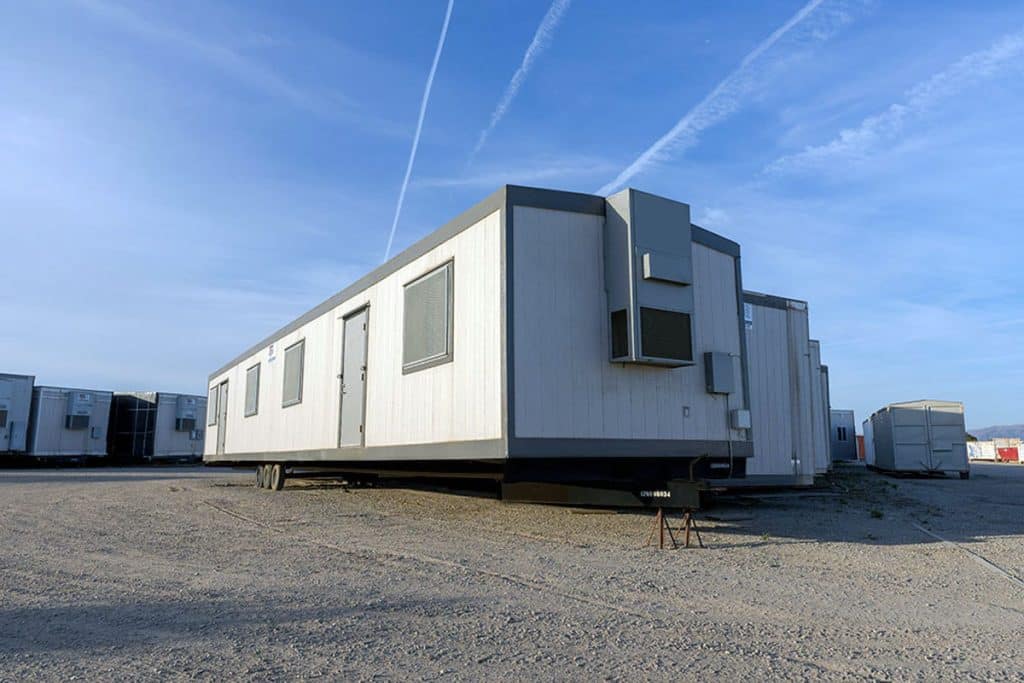
Office Trailer Rental In Houston
The deepest rental market in the state. Multiple national lessor yards, heavy petrochemical and industrial construction along the ship channel, and enough competition that it is worth taking three quotes rather than two. Gulf Coast placement adds wind considerations — expect tie-down counts at the higher end of the range and ask specifically about anchoring during hurricane season.
Office Trailer Rental In Dallas–Fort Worth
The most active general construction market in Texas, and the easiest place in the state to get a unit quickly. Commercial, data center and residential development all draw on the same fleet. Metroplex delivery distances are long enough that yard location genuinely affects transport cost — ask which yard the unit is coming from.
Office Trailer Rental In San Antonio And Austin
Growing fast, with fleet availability that lags demand more often than Houston or DFW. Lead times run longer, especially for restroom-equipped and double wide units. Booking earlier matters more here than the rate does.
Office Trailers In Midland, Odessa And The Permian Basin
A genuinely different market. Demand here is oilfield rather than general construction, and it moves with drilling activity rather than the building cycle. What changes:
- Availability swings hard. During an upswing, units are pulled from across the state and rates rise everywhere. During a slowdown, West Texas is where the surplus sits and the deals are.
- Remote sites need self-contained specs. Generator compatibility, water tanks, holding tanks rather than sewer connections. Confirm the unit is specified for a site with no utilities before it ships.
- Longer transport. Yards are concentrated in the metros, so a Midland or Odessa delivery often carries several hundred miles of transport in the quote.
- Dust and heat. HVAC sizing and filtration matter more than they do in Dallas. An undersized unit in a West Texas summer is a real problem.
Office Trailer Rental In El Paso And The Border
Served largely from Permian and New Mexico yards. Cross-border logistics and warehouse construction drive demand. Transport distance is the dominant cost variable.
Site Requirements In Texas
- Wind and anchoring. Coastal counties carry stricter wind design requirements than inland Texas, and tie-down counts scale with unit size. On the Gulf Coast this is not a formality.
- Expansive clay soils. Much of Central and North Texas sits on clay that moves seasonally. A pad that was level in January can be out by summer, and a long unit like a 12×60 shows it first. Ask about re-leveling on any placement over a year.
- Power. Typically 100 amps on a single wide and 200 on a double wide. On remote sites, confirm generator compatibility rather than assuming it.
- Water and sewer. Restroom-equipped units need a connection or a holding tank on a pumping schedule. On Permian sites, the tank is usually the answer.
Texas Office Trailer FAQ
How much does it cost to rent an office trailer in Texas?
Expect $200 to $425 per month for an 8×20, $500 to $900 for a 12×60 and $700 to $1,800 for a 24×60 double wide. No lessor publishes rates, so treat these as budgeting ranges. Texas quotes move with yard proximity and with Permian Basin drilling activity, which tightens fleet availability statewide when it picks up.
Do you need a permit to move an office trailer in Texas?
Any load wider than 8 feet 6 inches needs an oversize permit from TxDMV, which covers every 10-foot and 12-foot-wide office trailer. Escorts are a separate question and are not required until the load exceeds 14 feet wide, so a standard single wide needs a permit but no escort vehicle.
Does a 12-foot-wide office trailer need an escort in Texas?
No. Texas requires one escort above 14 feet wide and two above 16 feet. A 12-foot-wide single wide falls below both thresholds, so a delivery quote that includes an escort charge for one is worth questioning.
Does a Texas office trailer need TDLR approval?
It depends on installation rather than on the unit. A trailer that stays on its chassis for the length of a job is generally treated as a temporary structure by the local jurisdiction. A unit set permanently on a foundation generally falls under the TDLR Industrialized Housing and Buildings program and needs state approval before local occupancy. Confirm with your authority having jurisdiction before ordering, because state approval sits ahead of the delivery schedule.
Where can you rent office trailers in Texas?
All the national lessors operate Texas yards, with the deepest coverage in Houston and Dallas–Fort Worth and thinner coverage in West Texas. Because transport is often the largest single line on a Texas quote, which yard a unit ships from matters as much as the monthly rate. Comparing several suppliers is the only way to see that difference.
What size office trailer is best for a Texas construction site?
The 12×60 at 672 square feet is the volume seller and suits four to six people with two private offices. Smaller crews and gate offices use the 8×20 at 160 square feet. Above six or seven daily occupants, or where a conference room is needed, the answer is a double wide.
What should you specify for a Permian Basin site?
Assume no utilities. That means generator compatibility, a water supply tank, a holding tank rather than a sewer connection, and HVAC sized for West Texas heat with filtration that copes with dust. Confirm each of these is on the quote rather than assuming a standard unit covers them.
Compare Texas Office Trailer Quotes
Tell us the size you need and where in Texas it is going, and we will connect you with suppliers who have yards in range. Because transport is often the largest line on a Texas quote, comparing suppliers by yard location rather than by monthly rate is what shows the real difference. There is no cost and no obligation.
Related Guides
- Office Trailer Rental — rates, lease terms and sizes nationally
- Office Trailers For Sale — new and used pricing
- Double Wide Office Trailers — where the Texas escort threshold starts to matter
- 12×60 Office Trailer — the most common size in Texas yards