
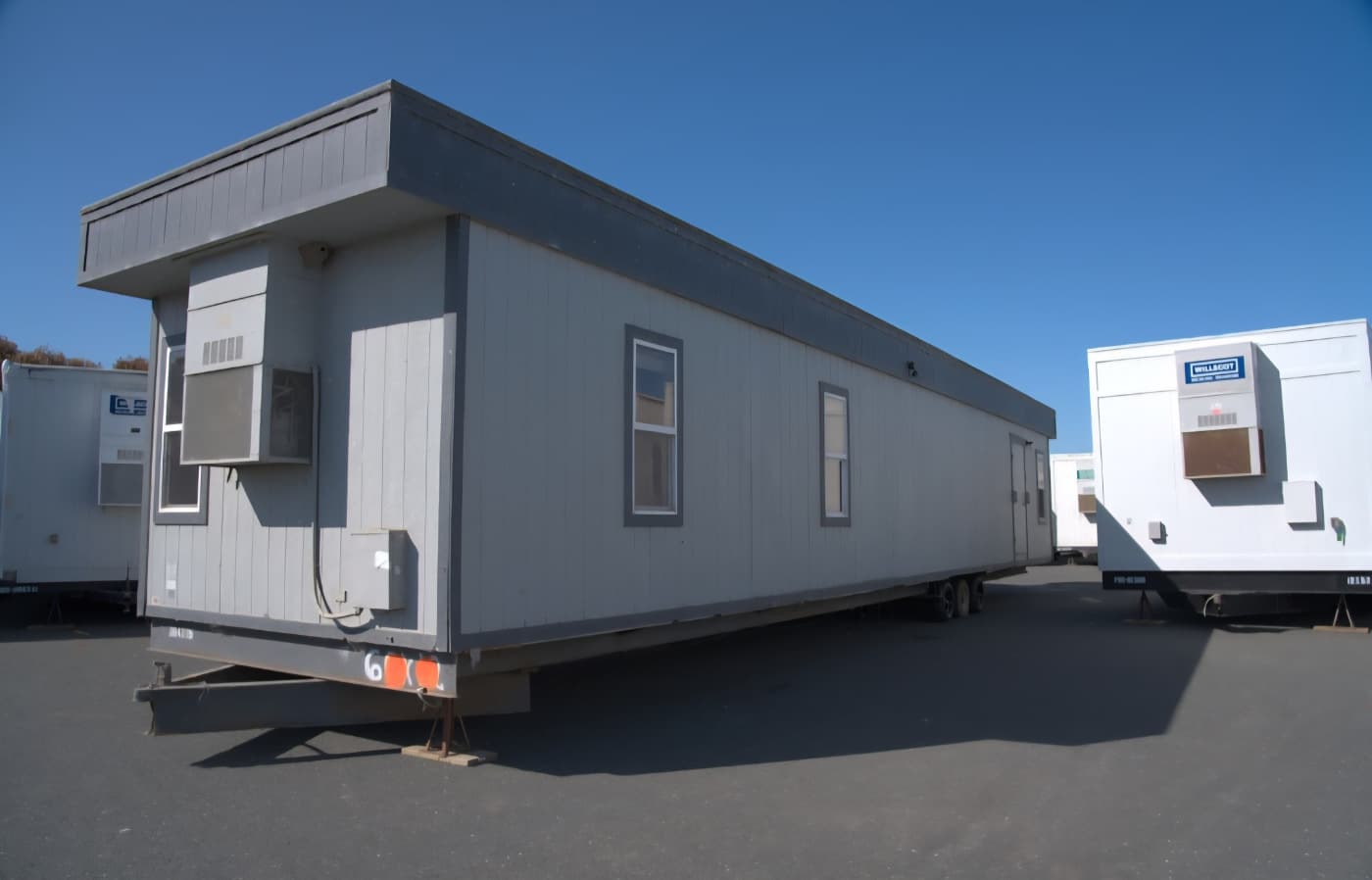
Used portable classrooms sell for roughly $45,000 to $120,000, against $130,000 or more for a comparable new unit. They also arrive in about half the lead time. The catch is not condition, which you can see. It is code vintage, which you cannot.
This guide covers what used portable and mobile classrooms cost, where to actually find them, the ownership math against leasing, and the ten-point inspection that stops you buying a building your state will not let you occupy.
Compare Used Classroom Pricing & Save
Used Portable Classroom Prices
| Unit | Square Feet | Used | New, For Comparison |
|---|---|---|---|
| 24×40 single classroom | 960 | from $85,000 | $130,000+ |
| 24×60 double classroom | 1,440 | from $120,000 | $250,000+ |
| Charter and smaller units | varies | $45,000 – $120,000 | — |
| Typical used range | — | $45,000 – $120,000 | $100,000 – $200,000 |
All figures exclude site work, delivery and installation, which apply to used units exactly as they do to new ones. Budget $15,000 to $25,000 for a real turnkey set including crane, blocking, tie-downs and connection, plus site preparation and an ADA ramp from $16,000.
Price on a used unit tracks three things above all: age relative to a 20 to 30 year service life, whether it meets current code, and how much refurbishment is included. A ten-year-old unit that has never been moved is a different proposition from a twenty-five-year-old unit on its third campus, even at the same headline price.
The Ownership Math
This is the argument for buying used, and it is stronger than most districts realize because it turns on resale value rather than purchase price.
| Five Years In A 24×60 Double Classroom | Lease | Buy Used |
|---|---|---|
| Monthly cost | ~$2,800 | — |
| Total paid over five years | $168,000 | $120,000 |
| Value retained at year five | None | ~$90,000 |
| Net cost of occupancy | $168,000 | ~$30,000 |
Used portable classrooms hold roughly 75% of their value over five years. That is the whole case. A leased classroom leaves you with nothing at the end of the term; a purchased one leaves you with an asset you can sell, relocate to another campus, or repurpose. Over five years the net cost of ownership can be a fifth of the cost of leasing the same building.
The crossover is around 36 months. At $2,800 a month, three years of rent comes to $100,800 against roughly $120,000 to buy used, so below three years leasing usually wins and above it ownership does. See our portable classroom rental guide for the leasing side of the comparison.
Where To Buy Used Portable Classrooms
Modular Dealers And Lessors
The large national lessors all run used inventory alongside their rental fleets, and units coming off lease are the most common source of good used stock. These are typically the best-documented units, often refurbished, and sometimes carry a limited warranty. They are also the most expensive used option.
Pre-Owned Modular Marketplaces
Marketplaces list units from dealers, districts and private sellers nationally. Wider selection and lower prices than dealer inventory, but you are responsible for inspection, transport and verifying code compliance.
School District Surplus And Auction
Districts replacing portables dispose of the old units, usually through public surplus auction. This is the cheapest route and the highest risk. Units are sold as-is, frequently with no documentation, and you inherit the removal cost.
Donated And Decommissioned Units
Districts and churches sometimes donate surplus portables outright to another school or nonprofit, with the recipient covering only removal, transportation and setup. Worth asking neighbouring districts directly whether anything is coming out of service, because these units rarely reach a public listing.
Free is not free. On a donated or auction unit, removal, transport, a new foundation, a ramp and utility connection still apply, and on an older building they can exceed what a documented dealer unit would have cost. Price the whole move before accepting a donation.
Structural Movers
Regional building-moving contractors often hold decommissioned school portables they have removed from campuses. Local, cheaper than national dealers, and the practical route in some markets.
Searching For Used Classrooms For Sale
Resale listings for the same building appear under at least six phrasings, and almost no seller uses more than two of them. This is the single biggest reason buyers conclude there is no local stock when there is.
Run all of these:
- used portable classrooms for sale — the dominant term, used by most modular dealers
- used mobile classrooms for sale — favored by suppliers who also deal in mobile offices
- second hand portable classrooms for sale — turns up different listings again, and is worth running even though it reads as a British phrasing; auction houses and some marketplaces index under it
- modular classrooms for sale and classroom modulars for sale — usually permanent units coming off a campus rather than relocatable portables
- school portable buildings for sale — district surplus listings often use this
- classroom trailers for sale — suppliers who came out of the construction trailer trade
The overlap between the result sets is smaller than you would expect. A unit listed as a second hand portable classroom by an auctioneer will not surface for someone searching used modular classrooms, and the two listings may be for buildings sitting in the same yard.
What The Phrasing Tells You About The Seller
The term is a reasonable signal about who you are dealing with and what the unit has been through.
| Listing Phrasing | Usually Means | What To Watch |
|---|---|---|
| Used portable classroom | Modular dealer or lessor fleet disposal | Best documented history; priced accordingly |
| Used mobile classroom | Mixed office and classroom fleet | Confirm it was actually used as a classroom, not an office |
| Second hand / surplus | Auction, district surplus, liquidation | Cheapest, least documented. Sold as seen |
| Modular classroom for sale | Permanent unit being removed from a campus | Chassis may be gone. Factor transport and a new foundation |
The chassis question decides the transport bill. A used portable classroom usually still has its running gear and can be towed. A used modular classroom that was set permanently often does not, which means a crane at both ends and a lowboy in between. That gap can be larger than the difference in asking price, and it is rarely mentioned in a listing.
Where District Surplus Actually Gets Listed
School districts disposing of portables are generally required to run a public process, which means the listing exists somewhere even when it never reaches a commercial marketplace. Check the district’s own procurement or surplus page, the state’s surplus property program, and the regional public-agency auction platforms before assuming a unit is not available. These are the listings most often described as school portable buildings for sale, and they are where the lowest prices sit — alongside the least recourse if something is wrong with the building.
The Ten-Point Inspection
In roughly the order that matters.
- State insignia and code vintage. The unit must satisfy current code in the state where it will sit, not the code it was built under. Verify the insignia exists and that your state will accept it. This is the single biggest risk in a used purchase and the one most likely to leave you with a building you cannot occupy.
- ADA compliance. Door clear widths, threshold heights, corridor widths and restroom fixtures on older units frequently predate current standards. Retrofitting is possible but rarely cheap.
- Roof condition and history. Water intrusion is what kills these buildings. Look for staining at ceiling perimeters and around penetrations, and ask directly whether the roof has ever been recoated or replaced.
- Floor system. Soft spots, delamination and sagging between joists indicate long-term moisture. Walk the whole floor, not just the middle.
- Frame and chassis. Check for rust, deformation and prior repair at the frame rails and outriggers. Every relocation stresses the structure.
- Relocation history. Ask how many times the unit has been moved and by whom. A unit on its first move is materially lower risk than one on its fourth.
- HVAC age and capacity. Usually the first significant replacement cost after purchase. Confirm the unit is sized for your climate, not the one it came from.
- Electrical panel and service. Confirm the panel capacity matches what you will connect it to, and that wiring meets current code for a Group E occupancy.
- Windows, doors and egress hardware. Exit doors must open from the egress side without a key or special knowledge, releasing with a single operation.
- Documentation. Original manufacturer records, state approval paperwork, title and any modification history. Missing documentation is a genuine problem at permitting time, not a paperwork inconvenience.
Have the inspection done by someone who is not the seller. On a $90,000 building with a $20,000 move attached, an independent inspection is the cheapest insurance available.
Code Vintage: The Risk Worth Understanding
A portable classroom built in 2005 was inspected and approved against the code in force in 2005. Codes have changed since, particularly around accessibility, energy performance and fire safety. When that unit is relocated and set on a new site, it becomes subject to your local authority’s current requirements.
How much of the current code applies varies by state and by how the relocation is classified. Some states treat a relocated modular building as an existing structure with limited upgrade obligations; others treat siting it as new construction. That difference can be tens of thousands of dollars.
Establish this before you buy, not after. Call your state’s modular buildings program and your local building department with the unit’s insignia number and year, and ask what will be required to permit it at your address. It is a fifteen-minute call that regularly changes which unit a district buys.
The same question is sharper for charter schools in California, where a charter on a public district campus falls under Division of the State Architect jurisdiction while a charter on private or leased property falls under HCD and needs HCD-insignia units. A used unit carrying the wrong insignia for your jurisdiction is not usable, however good its condition.
Refurbishment: What It Costs To Bring One Up To Standard
Most used units need some work. Common items, in rough order of frequency:
- Flooring replacement — the most common refurbishment, and the most visible to parents and staff
- Interior repaint and wall panel repair
- HVAC replacement — the largest single line item on an older unit
- Roof recoat or replacement
- Lighting upgrade to LED — often pays for itself in operating cost
- ADA retrofit — door widths, hardware, thresholds, restroom fixtures
- New ramp and steps — assume these do not come with the building
- Fire alarm integration with the main campus system
Dealers typically sell refurbished units with much of this already done, at a higher price. Auction and surplus units almost never include any of it. When comparing a $50,000 auction unit against an $85,000 dealer unit, the honest comparison includes the refurbishment gap and who carries the risk if something is found after purchase.
Lead Time On A Used Unit
A used portable classroom takes roughly half the lead time of a new build. Where a new unit runs 8 to 16 weeks from order to installation, an available used unit skips the factory queue entirely and is limited mainly by transport scheduling, site preparation and permitting.
That makes used units the practical answer for a district that discovers a capacity problem in June for an August start. It is also why used inventory moves quickly in spring, and why the best-documented units are gone by the time most districts start looking.
Used Portable Classroom FAQ
How much do used portable classrooms cost?
Roughly $45,000 to $120,000 depending on size, age and condition. A used 24×40 single classroom starts around $85,000 against $130,000 or more new, and a used 24×60 double around $120,000 against $250,000 or more new. Site work, delivery and installation are extra and apply the same as they would to a new unit, typically $15,000 to $25,000 for a turnkey set plus site preparation and a ramp from $16,000.
Is it worth buying a used portable classroom?
If the need exceeds about three years, usually yes. Thirty-six months of rent on a 24×60 comes to roughly $100,800 against about $120,000 to buy used, and the gap widens sharply after that. Over five years, leasing costs about $168,000 while buying used costs $120,000 with roughly $90,000 of resale value retained, making the net cost of ownership around $30,000. Used units hold roughly 75% of their value over five years.
Where can I buy used portable classrooms?
Four main routes. We can help you get quotes from licensed companies with wholesale pricing here.
National modular dealers and lessors sell units coming off lease, which are the best-documented and often refurbished but the most expensive. Pre-owned modular marketplaces list units nationally at lower prices with inspection left to you. School district surplus auctions are cheapest and highest-risk, sold as-is and often without documentation. Regional structural movers frequently hold decommissioned campus portables. Districts and churches also occasionally donate surplus units, with the recipient covering removal and transport.
What should I check before buying a used portable classroom?
Verify the state insignia and confirm your state will accept the unit’s code vintage, then check ADA compliance on door widths, thresholds and restrooms, the roof and floor for water damage, the frame for rust or prior repair, relocation history, HVAC age and capacity, electrical panel capacity, egress hardware, and that the original manufacturer and state approval documentation exists. Have the inspection done by someone other than the seller.
Can a used portable classroom fail to meet current code?
Yes, and it is the biggest risk in a used purchase. A unit approved under the code in force when it was built becomes subject to your local authority’s current requirements when it is relocated. Some states treat a relocated modular building as an existing structure with limited upgrade obligations while others treat siting it as new construction, a difference that can run to tens of thousands of dollars. Call your state modular program and local building department with the insignia number and year before buying.
How long do used portable classrooms last?
A well-maintained relocatable classroom generally lasts 20 to 30 years in total, so remaining service life depends on age and how well it was maintained. A ten-year-old unit that has never been relocated has substantially more life left than a twenty-five-year-old unit that has been moved three times, even at a similar price. Every relocation stresses the frame and connections.
How quickly can I get a used portable classroom?
Roughly half the lead time of a new build. New units run 8 to 16 weeks from order to installation; an available used unit skips the factory queue and is limited mainly by transport scheduling, site preparation and permitting. That makes used the practical option for a district that identifies a capacity problem in late spring for an August start, though the best-documented inventory tends to be gone by then.
Do used portable classrooms come with a warranty?
Usually not. New units typically carry a one-year warranty. Used units bought at auction or from a district almost never carry one. Refurbished units from a dealer sometimes carry a limited warranty on the work performed, which is part of what the higher dealer price buys.
Compare Used Portable Classroom Quotes
Used inventory is not centrally listed, prices are not published, and what is available changes week to week. The fastest way to see the real market is to put your requirement in front of several suppliers at once and find out what they actually have.
Tell us the size you need, your district and your timeline, and we will connect you with suppliers serving your area. It is free, there is no obligation, and your price is the same whether you come through us or contact the supplier directly.
Related Guides: Modular Classrooms · Portable Classroom Rentals · Commercial Modular Buildings · Office Trailers · Daycare & Preschool