
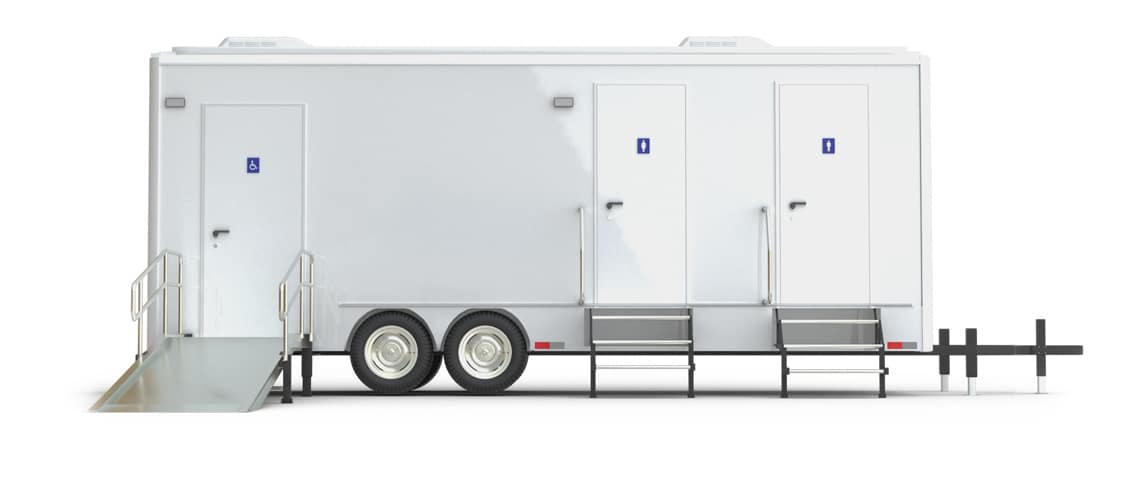
A handicap portable toilet rents for roughly $100 to $700 a week — about double a standard unit — and at most public events you need at least one no matter how small the order. The unit is nearly twice the footprint of a standard porta potty, weighs twice as much, and holds noticeably less waste, which changes both where it can go and how often it needs servicing.
This guide covers what an accessible unit costs, how many you are required to provide, the dimensions and clearances that make one compliant, where compliance actually fails, and when buying beats renting.
Handicap, ADA, Wheelchair Accessible: All The Same Unit
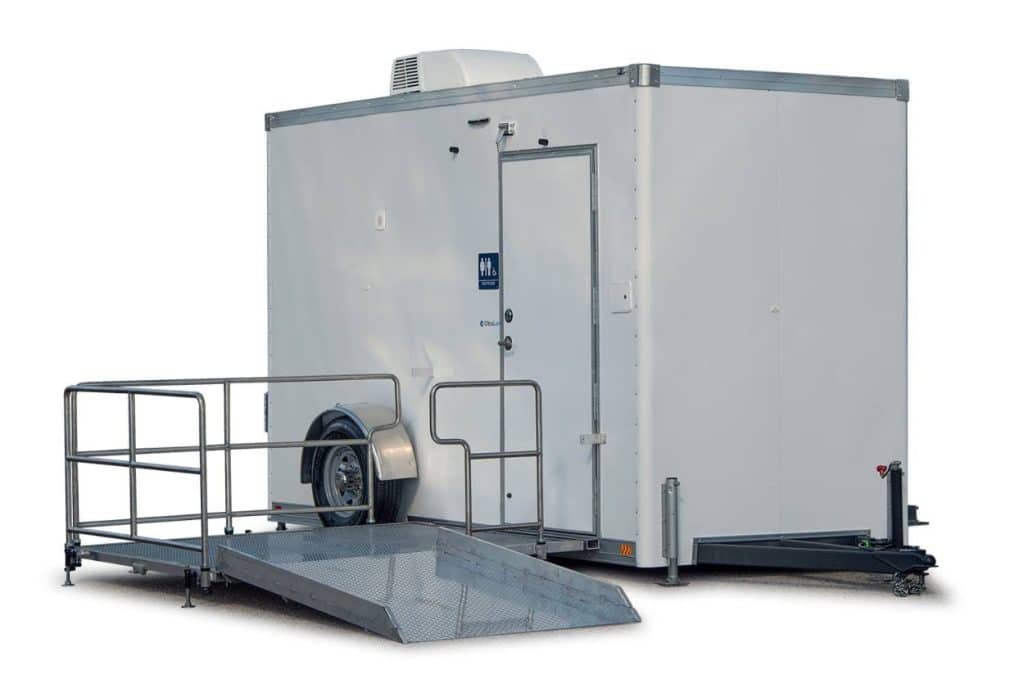
A handicap portable toilet, an ADA portable toilet, an ADA porta potty, a wheelchair accessible portable toilet, a portable toilet for handicapped users and a portable toilet for disabled users all describe one product. There is no specification difference between them.
The vocabulary splits by who is speaking. Rental and event companies say handicap portable toilets, or portable handicap toilets with the words reversed. Compliance documents, public agencies and procurement teams say ADA portable restrooms or ADA compliant. Accessibility organizations prefer accessible on its own. Facilities staff usually just say the accessible one.
This matters practically, because most suppliers index their inventory under a single phrasing. A yard listing stock as wheelchair accessible porta potties will not surface when you search handicap portable toilet rental, and both may be sitting in the same lot. Run more than one term before concluding your area is short.
Handicap Porta Potty Rental Cost
| Unit Type | Weekly | Monthly, Long Term |
|---|---|---|
| Standard, non-flushing | $50 – $475 | $50 – $475 |
| ADA / wheelchair accessible | $100 – $700 | $100 – $700 |
| Deluxe flushing, with sink | $100 – $850 | $125 – $3,400 |
The ranges are wide because portable restroom rental is a local business and rates vary enormously by market — a standard unit runs about $90 a week in Sacramento against $175 in Birmingham. The useful figure is not the absolute number but the multiple: an accessible unit costs roughly one and a half to two times the standard unit in the same market. If a supplier quotes you four times the standard rate, you are being priced on scarcity rather than on cost.
Accessible units run out before standard ones do. A service truck fits fewer of them per load and most yards stock them in far smaller numbers, so in peak season a supplier with plenty of standard inventory can still have nothing accessible for your date. This is the single best reason to order early rather than add the accessible unit later, and it is why late orders carry a premium that has nothing to do with the unit itself.
Servicing is normally one weekly clean, included. Additional visits run $25 to $75 each — and see the tank capacity note below, because accessible units often need them sooner than the standard units beside them.
How Many Accessible Units Do You Need?
The working rule is one accessible unit minimum, then one per twenty standard units. That is the practical form of what the 2010 ADA Standards say, and the actual wording is worth reading because it is framed as a ceiling rather than a floor.
Section 213.2, Exception 3 provides that where multiple single-user portable toilet units are clustered at a single location, no more than 5 percent of the units at each cluster are required to comply. It caps how many you must provide. The obligation to provide accessible facilities at all comes from the general requirement, which is why one unit is the practical floor for any public event regardless of how few you order.
The Five Percent Is Per Cluster, Not Per Site
This is the detail that gets missed most often and the one most likely to cause a real problem. Four separate banks of toilets spread across a festival ground are four clusters, and each one needs its own accessible unit. Ordering a single accessible unit for the whole site and placing it at the main gate does not satisfy the requirement, and it does not serve the person who needs it either — they are at the far end of the site with the other three banks.
Accessible Units Have To Be Marked
The same exception requires compliant units to be identified with the International Symbol of Accessibility. Rental units usually arrive with the decal applied, but confirm it, because an unmarked accessible unit in a row of identical-looking cabins is invisible to the person looking for it. Where the units are not adjacent, directional signage at the standard banks is worth adding.
Handicap Portable Toilet Dimensions And Specifications
| Standard Unit | ADA / Accessible Unit | |
|---|---|---|
| Width | 43 – 44 in | 60 – 67 in |
| Depth | 46 – 48 in | 60 – 87 in |
| Height | 88 – 90 in | 90 – 91 in |
| Weight, empty | 160 – 200 lbs | 250 – 400 lbs |
| Waste tank | 60 – 70 gal | 35 – 50 gal |
| Entry | Step up over a threshold | Ground level, no threshold |
| Interior | Stand and turn | 60-inch turning circle |
| Grab bars | None | Both sides at the toilet |
| Flooring | Standard | Anti-slip surface |
The accessible unit is bigger but holds less. Twice the footprint and twice the weight, and a waste tank roughly 40 percent smaller — the floor space a wheelchair needs comes out of the tank. A standard unit is generally rated for 150 to 200 uses between services; an accessible unit reaches its limit sooner. On a long placement or a heavy event, the accessible unit can need servicing more often than the standard units next to it, and almost nobody prices that in. Ask how the service schedule handles it rather than assuming one weekly visit covers everything.
The size difference has a second consequence: an accessible unit occupies roughly the space of two standard ones on site, so if you are working to a tight footprint, the accessible unit is the one to place first and fit the others around.
The Route Matters As Much As The Unit
This is where compliance actually fails, and it is almost never mentioned in a rental quote.
An accessible unit at the end of a gravel path is not accessible. The unit has to sit on a firm, stable, level surface, with a route to it that a wheelchair can actually use. That rules out loose gravel, soft turf after rain, a placement reached only by stepping over a cable ramp or a curb, and any approach with a meaningful slope.
The practical checklist:
- Surface. Pavement or compacted ground. If the only workable spot is grass, budget for ground protection matting — it costs far less than the unit and is the difference between compliant and not.
- Approach. Flat, firm, and wide enough. Check the whole route from where people actually are, not just the last few feet.
- Clear space at the door. Enough room beside the entry for someone to transfer. A unit wedged tightly into a bank of standard toilets can be technically compliant and practically unusable.
- Level ground for the unit itself. An accessible unit on a slope loses the interior clearances that make it compliant in the first place.
- Service truck access. The same as any unit — a toilet a pump truck cannot reach cannot be serviced.
Tell the supplier what the last hundred feet look like when you book. They place these for a living and will tell you whether it works, but only if you describe it.
Events, Construction Sites And Long Placements
Public events. Provide at least one accessible unit regardless of size, one per cluster, and place them where people actually are. This is the setting where the requirement is clearest and where failure is most visible.
Construction and job sites. OSHA sets how many toilets a site needs by headcount, but it does not address accessibility — the two are separate obligations and neither substitutes for the other. If a worker on site needs an accessible unit, that requirement comes from employment law rather than the sanitation count, and it applies regardless of how the OSHA math works out. Adding a handicap porta potty to the original order costs a fraction of sorting it out mid-project.
Long-term placements. Parks, trailheads, campgrounds, seasonal facilities and municipal sites are where the rental math starts to look bad, because the accessible unit’s higher weekly rate compounds over months. See the purchase section below.
Handicap Portable Toilets For Sale
Two very different products come up under handicap portable toilets for sale, handicap porta potty for sale and ADA porta potty for sale, and the listings rarely make the distinction clear.
| Info | Used Plastic Unit | Steel-Frame Accessible Restroom |
|---|---|---|
| What it is | The same moulded cabin a rental company uses, sold off the fleet | An insulated steel building with fixtures, sink and finished interior |
| Typical price | Low thousands | $9,000 – $11,000 |
| Connections | None — holding tank | Level pad, usually water and waste |
| Suits | Contractors, farms, occasional use | Venues, parks, campgrounds, permanent placements |
| Servicing | You arrange pumping | Plumbed, or tanked with pumping |
A used handicap porta potty is the cheaper route and is genuinely sensible for a contractor who needs one on rotation — but it is the same plastic cabin, with whatever wear the fleet put on it, and you take on the pumping arrangements yourself.
The Break-Even On An Accessible Unit
Accessible units rent at roughly double the standard rate, which pulls the break-even in considerably faster than it comes for standard stock. At a mid-market accessible rate of around $250 a week, a $9,000 steel-frame accessible restroom pays for itself in roughly nine months of continuous placement — and it is a finished building rather than a plastic cabin at the end of it.
That makes ownership a serious option for anywhere with a permanent need: a venue, a municipality, a campground, a park, a fairground. For a one-off event, rent. If you are buying, see the accessible models available — steel-frame restrooms including handicap-accessible and toilet-with-shower configurations.
Handicap Portable Toilet FAQ
How much does a handicap portable toilet cost to rent?
Roughly $100 to $700 a week, against $50 to $475 for a standard unit — about one and a half to two times the standard rate in the same market. Rates vary enormously by location, so the multiple is more useful than the absolute figure. One weekly cleaning is normally included; additional service visits run $25 to $75 each.
How many ADA porta potties am I required to have?
The working rule is one minimum, then one per twenty standard units. The 2010 ADA Standards, Section 213.2 Exception 3, cap the requirement at 5 percent of the units in each cluster — and the key word is cluster. Four separate banks of toilets across a site are four clusters, each needing its own accessible unit. One accessible unit at the main gate of a large site does not satisfy the requirement.
What is the difference between a handicap and an ADA portable toilet?
Nothing. Handicap portable toilet, ADA portable toilet, ADA porta potty, wheelchair accessible portable toilet and portable toilet for disabled users all describe the same product. Suppliers pick one phrasing and index their stock under it, so search more than one term when checking local availability.
What are the dimensions of an ADA portable toilet?
Roughly 60 to 67 inches wide and 60 to 87 inches deep, against 43 to 44 by 46 to 48 for a standard unit — close to double the footprint. Height is similar at 90 to 91 inches. The extra floor space provides the 60-inch turning circle a wheelchair needs. Empty weight runs 250 to 400 pounds, against 160 to 200 for a standard unit.
Why does an accessible unit need servicing more often?
Because the waste tank is smaller. Accessible units hold roughly 35 to 50 gallons against 60 to 70 in a standard unit — the floor space comes out of the tank. A standard unit is generally rated for 150 to 200 uses between services and an accessible unit reaches its limit sooner, so on heavy use it can need servicing ahead of the standard units beside it.
Does a handicap porta potty need to be on pavement?
It needs a firm, stable, level surface and a route to it that a wheelchair can use. Pavement or compacted ground is ideal. Grass works with ground protection matting, which costs far less than the unit. Loose gravel, soft turf and any approach requiring a step over a curb or cable ramp do not work — this is where compliance most often fails, and it is almost never covered in a rental quote.
Do construction sites need accessible portable toilets?
OSHA sets toilet counts by headcount and does not address accessibility; they are separate obligations. If a worker on site needs an accessible unit, that requirement comes from employment law rather than the sanitation count and applies regardless of the OSHA math. Adding one to the original order costs far less than resolving it mid-project.
Do accessible units have to display the accessibility symbol?
Yes. Section 213.2 Exception 3 requires compliant portable units to be identified with the International Symbol of Accessibility. Rental units usually arrive with the decal, but confirm it — an unmarked accessible unit in a row of identical cabins is invisible to the person looking for it. Where units are not adjacent, add directional signage at the standard banks.
Can I buy a handicap portable toilet instead of renting?
Yes, and two different products come up. A used plastic unit off a rental fleet costs low thousands and suits a contractor needing one on rotation. A steel-frame accessible restroom with fixtures and a sink runs $9,000 to $11,000 and is a finished building. Because accessible units rent at roughly double the standard rate, the break-even arrives faster than it does on standard stock — around nine months of continuous placement on a mid-market rate.
How far in advance should I book an accessible unit?
Earlier than you would book standard units. Service trucks fit fewer accessible units per load and most yards hold far smaller numbers of them, so a supplier with plenty of standard inventory can still have none accessible for your date in peak season. Order it with the rest of the job rather than adding it later.
Compare Handicap Portable Toilet Quotes & Save
Tell us how many units you need, whether the site is an event or a job site, and where it is, and we will connect you with suppliers who carry accessible units in your area. Say up front how many accessible units you need — it affects both availability and price more than any other line on the order. There is no cost and no obligation.
Related Guides
- Portable Restrooms — standard porta potty rental and purchase, OSHA ratios, unit types
- Restroom Trailer Rental — multi-stall flushing trailers, including ADA options